50
50
Clinical Insight
P R O B E
• V o l . L I I I • N o . 3 • A p r – J u n 2 0 1 4
Herb News
In traditional ayurvedic medicine, Ashvagandha
(
Withania somnifera
) root is used to promote general
strength and vitality. Several human studies have been
published in recent years, collectively showing that this
plant’s root, when ingested either in dried form or in
extract form decreases stress and improves quality of life;
improves sexual function in males; increases immunity;
improves cardiorespiratory endurance and neuromuscular
coordination; and alleviates fatigue and weakness in
perimenopausal and postmenopausal women. Ashvagandha
root is also reported to be an adaptogen.
The present observational, dose-response study was
designed to assess the safety and tolerability of escalating
doses of Ashvagandha in healthy subjects, as measured by
vital signs and hematological and biochemical parameters.
Secondary endpoints were the percentage of body fat, lean
body weight, muscle strength, and exercise tolerance. It was
a single-arm study with no placebo control group.
Included participants were males or females, 18 to 30 years
old with a BMI of 19 to 30 kg/m
2
and who had not taken
any medications, supplements, or adhered to any exercise
regimen within the previous month of the study. Those that
had taken or donated blood within 3 months of the study
were excluded. Potential participants were subjected to
physical examination, assessment of organ function, chest
X-ray, and electrocardiogram (ECG).
A total of 18 individuals were enrolled in the study. At
baseline, the mean age of the individuals was 24.33 ± 2.14
years, mean height was 165.94 ± 7.43 cm, mean weight was
66.65 ± 8.79 kg, and mean BMI was 24.28 ± 2.70 kg/m
2
.
None of the individuals smoked or used tobacco/alcohol.
The test material was gelatin capsule containing 250 mg
or 500 mg of 8:1 pulverized aqueous root extract of
Ashvagandha. For a 30-day period, doses of Ashvagandha
aqueous extract were increased in 10-day intervals, starting
at 250 mg in the morning and 500 mg in the evening on
days 1 to 10 (750 mg/day). From days 11 to 20, 500 mg was
administered in the morning and 500 mg was administered
in the evening (1000 mg/day). The dosage on days 21 to
30 was 500 mg in the morning and 750 mg in the evening
(1250 mg/day).
Vital signs, body weight, BMI, ECG, exercise tolerance,
muscle strength, and blood panels were assessed at baseline
and on days 11, 21, and 31. The blood panels included
hematological (erythrocyte sedimentation rate; platelet,
hemoglobin, and differential counts; RBC and WBC
counts), organ and metabolic function (serum bilirubin,
protein, albumin, alanine transaminase [ALT], aspartate
transaminase [AST], alkaline phosphatase, uric acid, and
fasting blood glucose), and lipid (total cholesterol, high-
density lipoprotein [HDL], low-density lipoprotein [LDL],
and very-low-density lipoprotein [VLDL]) parameters.
Exercise tolerance was measured by cycle ergometer and
muscle strength was assessed by hand grip, quadriceps, and
back extensor force. Body fat percentage and lean body
weight were measured by skin fold thickness at the biceps,
triceps, and subscapular and suprailiac areas.
There were no significant changes in vital signs (body
temperature, pulse, blood pressure, and respiration rate),
body weight, or hematological parameters during the study.
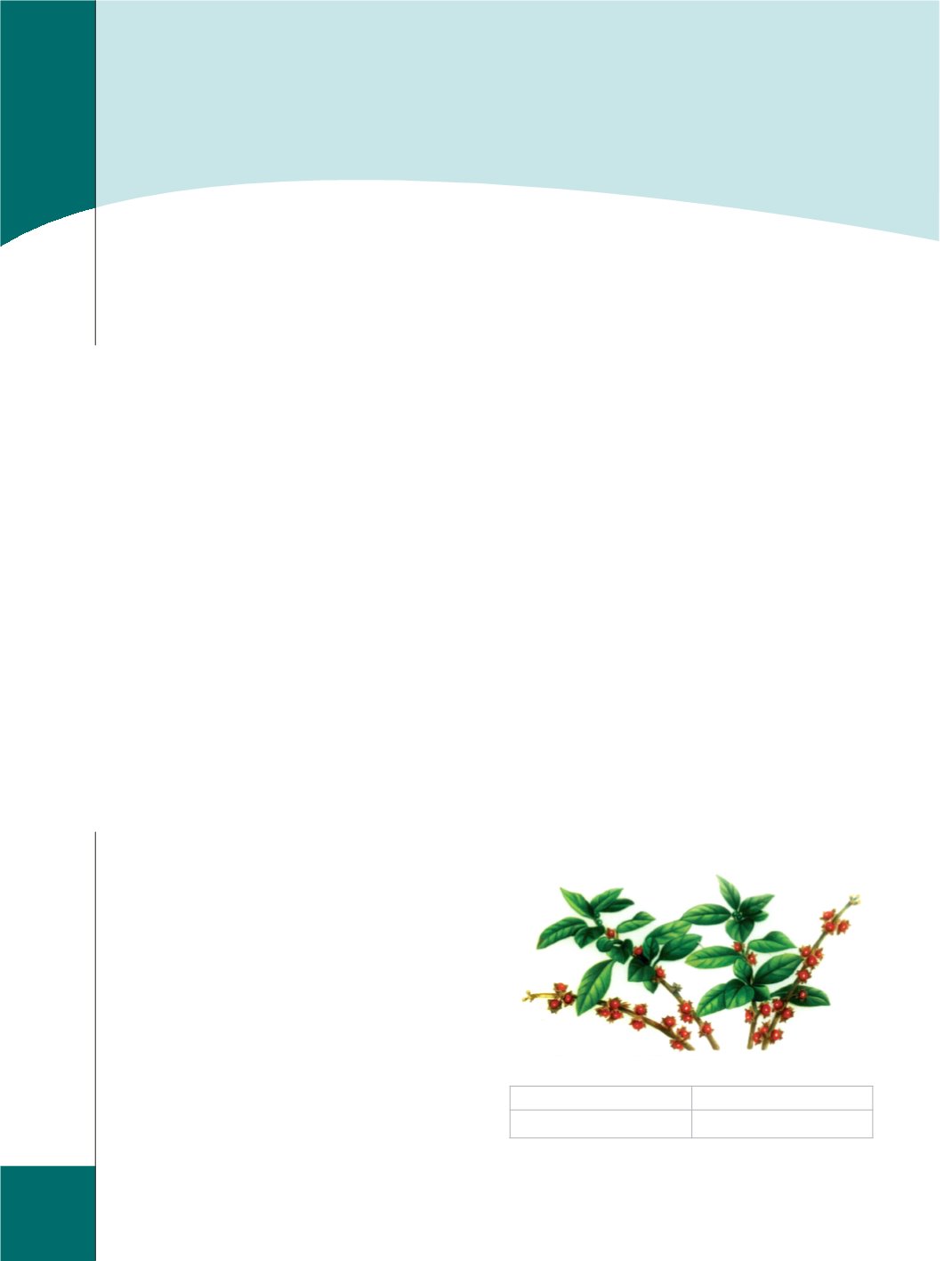
Ashvagandha in Healthy Humans: Physiological
Effects and Safety
Sanskrit/Indian name:
Ashvagandha
Latin name:
Withania somnifera
Ashvagandha


