24
Clinical insight
P R O B E
• V o l . L I I I • N o . 3 • A p r – J u n 2 0 1 4
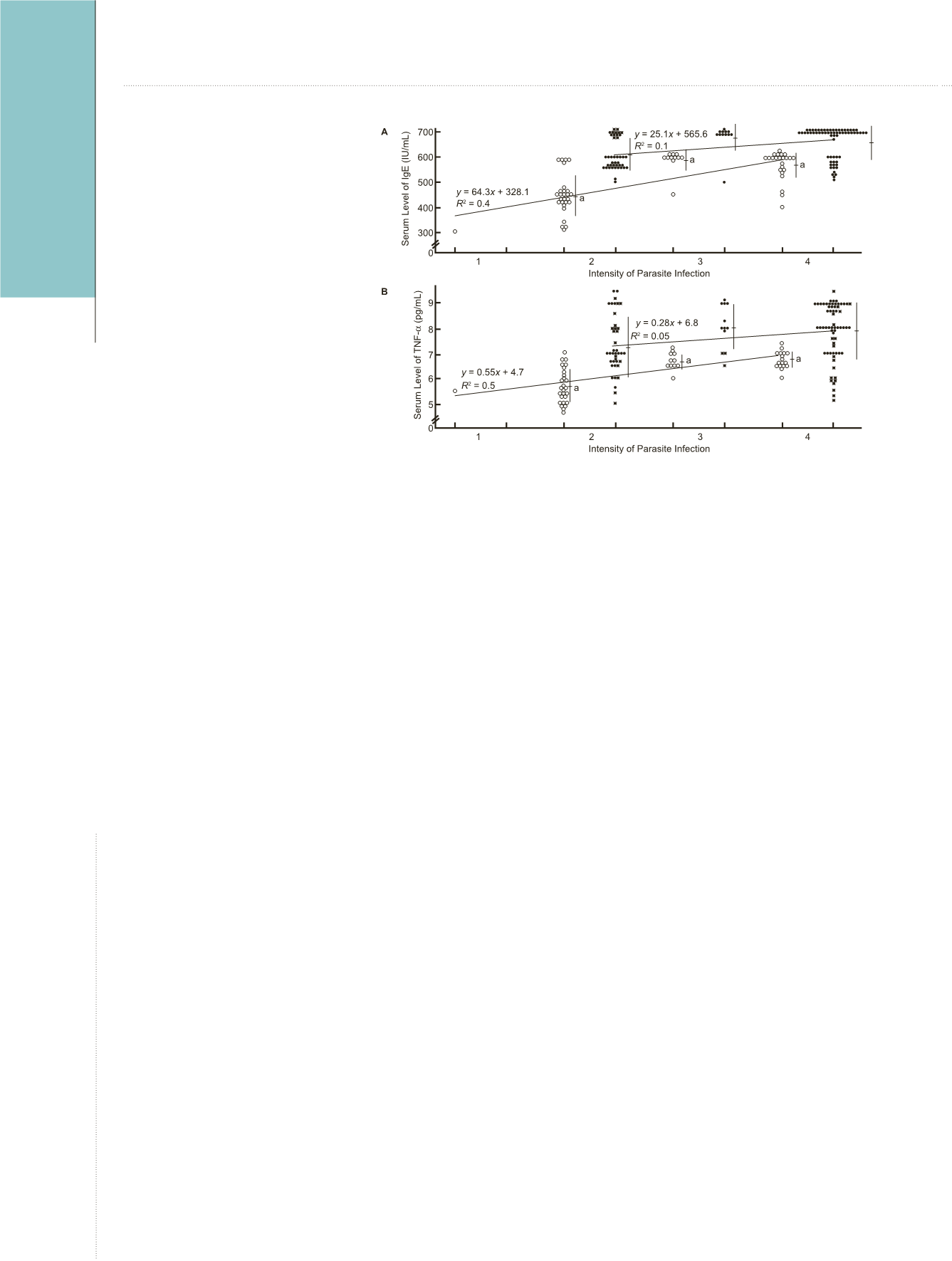
other hand, in the non-breastfed
group, there was a positive correlation
between them, although there were
no significant differences. The serum
level of IgE tended to be higher in
infants infected with 2 parasites than
in those with a single parasite in the
non-breastfed group. With regard to
the comparison in the same infection
intensity, the levels of IgE and
TNF-
α
in the breastfed group were
significantly lower than those in the
non-breastfed group (
P
< .01)
(Figure 2).
Discussion
Persistent diarrhea should prompt
investigation for protozoan
infections, mainly of
Giardia
and
Cryptosporidium
. Protozoan parasites,
which were detected in the study,
were the main causes of diarrhea.
Diarrhea was not with an acute onset
and was not associated with high
fever or vomiting. Infants, infected
with protozoan parasites, were treated
successfully with anti-protozoan
drugs.
This study clearly indicated that the
percentage of protozoan parasite-
infected infants in the breastfed group
was significantly less than that of the
non-breastfed group. The numbers
of infants infected with the same
protozoan parasites in the breastfed
group were also significantly lower
than those of the non-breastfed group.
In addition, the intensities of parasite
infections were less in the breastfed
group than those in the non-breastfed
group. Increased risks of persistent
diarrhea are environment-related,
such as poor hygiene. In this study,
both macroenvironmental measures
(provision of a safe and adequate water
supply, and hygienic waste disposal)
and microenvironmental measures
(handwashing, hygienic storage
and use of water, and avoidance of
Figure 2.
Serum Levels of IgE and TNF-α and Intensity of Parasite Infection (
A
) IgE (
B
) TNF-α
Open circles, breastfed group; filled circles, non-breastfed group; X, infants infected with
mixed parasites. Values are expressed as means ± SD.
a
P
< .01 between breastfed and non-breastfed group in same intensity of parasite infections.
stale/cold-storage infant foods in
tropical environments) were poor in
both groups. Lack of access to clean
water, sanitation, and hygiene are
strong drivers for IPI. Thus, scaling
up environmental control measures
and safe water and hygiene strategies
is important to prevent persistent
diarrhea in children.
IgE activates platelets and induces
cytotoxic functions against parasites.
An elevation in total IgE levels was
also reported even in helminth
and protozoan infectious diseases,
such as, cryptosporidiosis and
giardiasis. Excretory and secretory
proteins released by
G intestinalis
are
responsible for production of a specific
IgE. In this study, the serum level of
IgE was significantly elevated in both
parasite-infected groups compared
to the non-infected infants. The IgE
levels of infants infected with the
respective parasites of the breastfed
group were significantly lower than
those of the non-breastfed group
in this study. The IgE level and the
intensity of parasite infections were
related in the breastfed group. In
addition, the IgE level of the breastfed
group was lower than that of the
non-breastfed group with the same
intensity of parasite infections. Some
factors such as immune activation by
protozoa might be different between
the breastfed and non-breastfed
groups. This will be the subject of
a future study. The higher total IgE
levels in non-breastfed infants were
not due to cow’s milk-specific IgE;
such antibodies could not be detected
in the infant group fed with cow’s
milk. Regarding the relation of
breastfeeding and IgE levels in the
early childhood of healthy infants,
there are some contradictory reports.
Total IgE level was significantly lower
in breastfed infants compared with
formula-fed infants, while another
report showed no feeding-related
differences in the IgE level in the first
6 months of life.
Protozoan infections of the
intestinal tissue will lead to a
robust inflammatory process and
production of a wide range of
cytokines including TNF-
α
that is
Abdel-Hafeez, et al.
Breast-feeding Protects Against Infantile Diarrhea


