17
Clinical insight
P R O B E
• V o l . L I I I • N o . 3 • A p r – J u n 2 0 1 4
Karamakar D, et al.
Meta-analysis of Efficacy and Safety Studies of Cystone
Table 3. Effect of Cystone and Other Treatments on Burning Micturition, Bacteriuria,
and Pus Cells
Parameter
Cystone
Other Treatment
Protection %
Treatment Present
Absent
Present
Absent
Cystone
Other
Treatment
Burning
Micturition
Before
433
0
26
0
81.97 53.85
After
76
357
(
P
<
.0001)
12
14
(
P
<
.0001)
Bacteriuria
Before
276
0
111
0
74.28 62.16
After
71
205
(
P
<
.0001)
42
69
(
P
<
.0001)
Pus Cells
Before
200
0
121
0
78.5 94.21
After
43
157
(
P
<
.0001)
7
114
(
P
<
.0001)
Dosage: Cystone 2 tablets, TID for 1–6 months.
Other treatment: Burning micturition: Patients were given urinary antiseptics such as
nitrofurantoin, ampicillin, cotrimoxozole, sulphonamides, or chloramphenicol alone.
Bacteriuria: Ampicillin 250 mg, 6 hourly for 7 days, Alkaline mixture and cotrimoxozole 2
BID for 5 days
Pus cells: Conventional therapy for UTI or antibiotics prescribed based on culture
sensitivity reports.
Statistical analysis: Fisher exact test.
Table 4. Adverse Drug Reactions
Adverse Effects
No. of Patients
Dyspepsia
3
Flatulence
4
Gastric Irritation
5
The analysis also indicates that
Cystone brings about significant
symptomatic relief, as compared to
other treatment group, in burning
micturition, and also reduces
bacteriuria and pus cells in patients
with UTI (Table 3).
Adverse effects
In all, 1837 patients had received
Cystone at a dosage of 2 tablets
thrice a day for a period ranging
from 2 weeks to 2 years. The adverse
effects reported in these studies were
dyspepsia, flatulence, and gastric
irritation (Table 4).
However, none of the patients had
to be withdrawn because of adverse
effects. In addition, there were no
reports of any serious adverse effects or
of mortality due to Cystone.
Discussion
Humankind is known to be afflicted
by urinary stone disease. Hippocrates,
in the 4th century BCE, noted renal
stones together with a renal abscess
and wrote in the Hippocratic Oath,
“I will not cut for stone,” although
he was not an urologist.
53
Urinary
stone disease has always been a
common disease. Currently, urinary
stone formation affects 10% to 12%
of the population in industrialized
countries and the peak incidence
seems to be at ages between 20 and 40
years.
54
Until the 1980s, urinary stone
disease was a major health problem
with a significant percent of patients
undergoing severe surgical procedures
for disease, in contrast to Hippocrates.
Because of the morbidity and
mortality of these surgical procedures,
some oral drugs are used to treat this
disease but adverse effects compromise
their long-term consumption. On
the other hand, some herbal remedies
have been used to treat urinary
stone disease, although scientific
principles have been lacking. Today,
there is an understanding of many
pathophysiological features underlying
urinary stone disease and the
mechanism of herbal remedies that
can have a role in the formation and
treatment of urinary stones.
Phytotherapy might be an alternative
treatment with an effective, safe, and
culturally acceptable nature. Although
some oral medications have positive
effects, they are not effective in all
patients. Oral citrate is one of the
most widely used medical therapies
for preventing urinary stone disease.
55
However, this drug is not tolerated
by all patients and some patients are
still active stone formers during this
therapy.
56
Due to the adverse effects
of these drugs, alternative treatment
modalities composed of herbal
remedies have been the mainstay
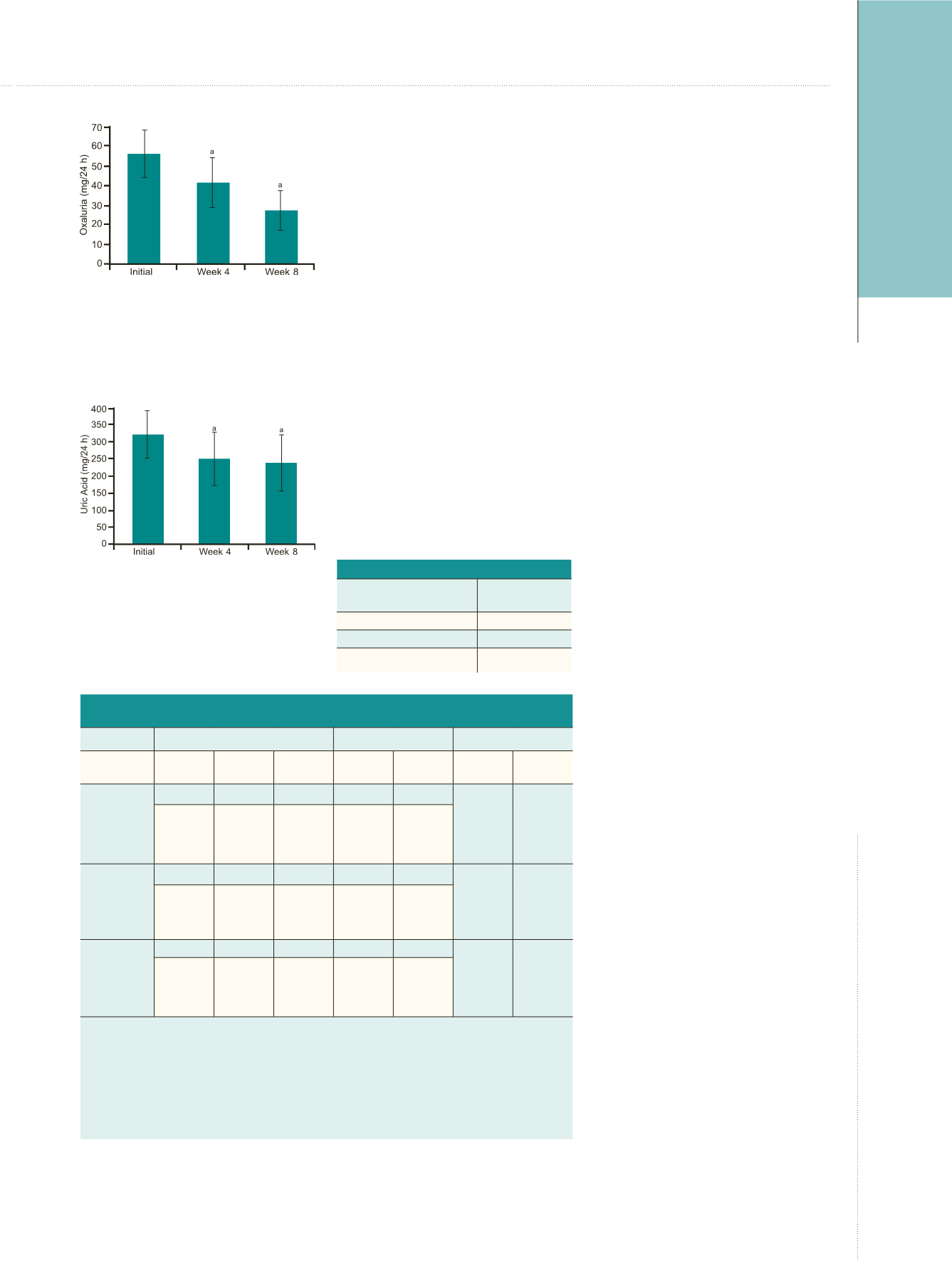
Figure 2.
Effect of Cystone on Urinary
Excretion of Oxalate in Stone Formers (n =
222). Data represents mean ± SD at each
week of treatment.
a
P
< .01 as compared to initial value. The
levels observed in normal patients (n = 19)
oxaluria was 19.93 mg/24 h.
Figure 3.
Effect of Cystone on Urinary
Excretion of Uric Acid in Stone Formers (n
= 119). Data represents mean ± SD at each
week of treatment.
a
P
< .01 as compared to initial value. The
levels observed in normal patients (n = 19)
for urine acid was 180.17 mg/24 h.


