16
Clinical insight
P R O B E
• V o l . L I I I • N o . 3 • A p r – J u n 2 0 1 4
Karamakar D, et al.
Meta-analysis of Efficacy and Safety Studies of Cystone
follow a reasonable temporal sequence
from the administration of the drug;
“possible,” follows a known response
pattern to the suspected drug, but
could have been produced by the
patient’s clinical state or other modes
of therapy administered to the patient;
and “probable,” follows a known
response pattern to the suspected drug
that could not be reasonably explained
by the known characteristics of the
patient’s clinical state.
Primary endpoint
The predefined primary endpoints in
majority of these studies have been
clearance of renal calculi and relief
from clinical symptoms.
Statistical analysis
Statistical analysis was done according
to intention-to-treat principles.
Changes in various parameters from
baseline values and values at the
end of the study were pooled and
analyzed cumulatively using Fisher
exact test, paired
t
test or repeated
measures of ANOVA, followed by
Dunnett multiple comparison test.
Values are expressed as mean ± SD
or as incidences of patients with or
without symptoms. The minimum
level of significance was fixed at 95%
confidence limit and a 2-sided
P
value
< .05 was considered significant.
Statistical analysis was performed
using GraphPad Prism software
(version 4.01).
Results
In all, 50 clinical trials have been
taken into account, which involved
3037 patients (Cystone, 1837; others,
1200) of either sex. The age range of
patients included in all studies was
1 to 72 years and the duration of
treatment was 2 weeks to 2 years.
In 636 patients, data was available
regarding the calculi size and analysis
of this data indicates that there was
a significant decrease in presence
of renal calculi and the calculi size
decreased from 6.21 ± 4.24 mm to
0.57 ± 0.79 mm (
P
< .0067) (Table 1).
In one of the studies, antispasmodic
medications, forced diuresis, and IV
fluids were used in 50 patients, which
also showed significant decrease in
presence of renal calculi (Table 1).
Coming to the effect of Cystone
on clearance of calculi based on its
location (Table 2), it appears that
Cystone, though effective in renal,
ureteric, and vesical calculi, shows
better results in ureteric calculi as
compared to other sites. The clinical
response in ureteric calculi was
89.96% whereas in renal calculi it was
73%. The results also indicate that
in renal calculi, 27% of the patients
required interventional surgery as
Table 2. Effect of Cystone on Clearance of Calculi Based on its Location
Location
No. of
Trials
No. of
Patients
Age
(years)
Dosage
Duration of
Treatment
Clearance
of Calculi
Response
Surgery
Renal
21
71
1–72
2 TID
1 TID
(P)
2 weeks–
6 months
52
(73.24%)
19
(26.76%)
(
P
< .0001)
Ureteric 36
528 1–72
2 TID
1 TID
(P)
2 weeks–
6 months
475
(89.96%)
53
(10.04%)
(
P
< .0001)
Bladder/
vesical
15
37
1–60 2 TID
2 weeks–
6 months
31
(83.78%)
6
(16.22%)
(
P
< .0001)
(P), pediatric patients.
Percent response is shown in parenthesis.
Statistical analysis: Fisher exact test.
Table 1. Effect of Cystone on Clearance of Renal Calculi and Calculi Size
Parameter
Cystone
Other Treatment
a
Before
Treatment
After Treatment
Before
Treatment
After Treatment
Presence of
Renal Calculi
636
78 (87.73%)
(
P
< .0001)
50
12 (24.00%)
(
P
< .002)
Calculi Size
(mm) (n = 339)
6.21 ± 4.24
0.57 ± 0.79
(
P
< .0067)
NA
NA
NA, not available.
Statistical analysis: Fisher exact test for presence of renal calculi, and paired
t
test for
calculi size.
a
Antispasmodics (tablets in mild cases and parenteral injections in cases of severe colic),
forced dieresis, and IV fluids.
compared to only 10% of patients in
case of ureteric calculi (Table 2).
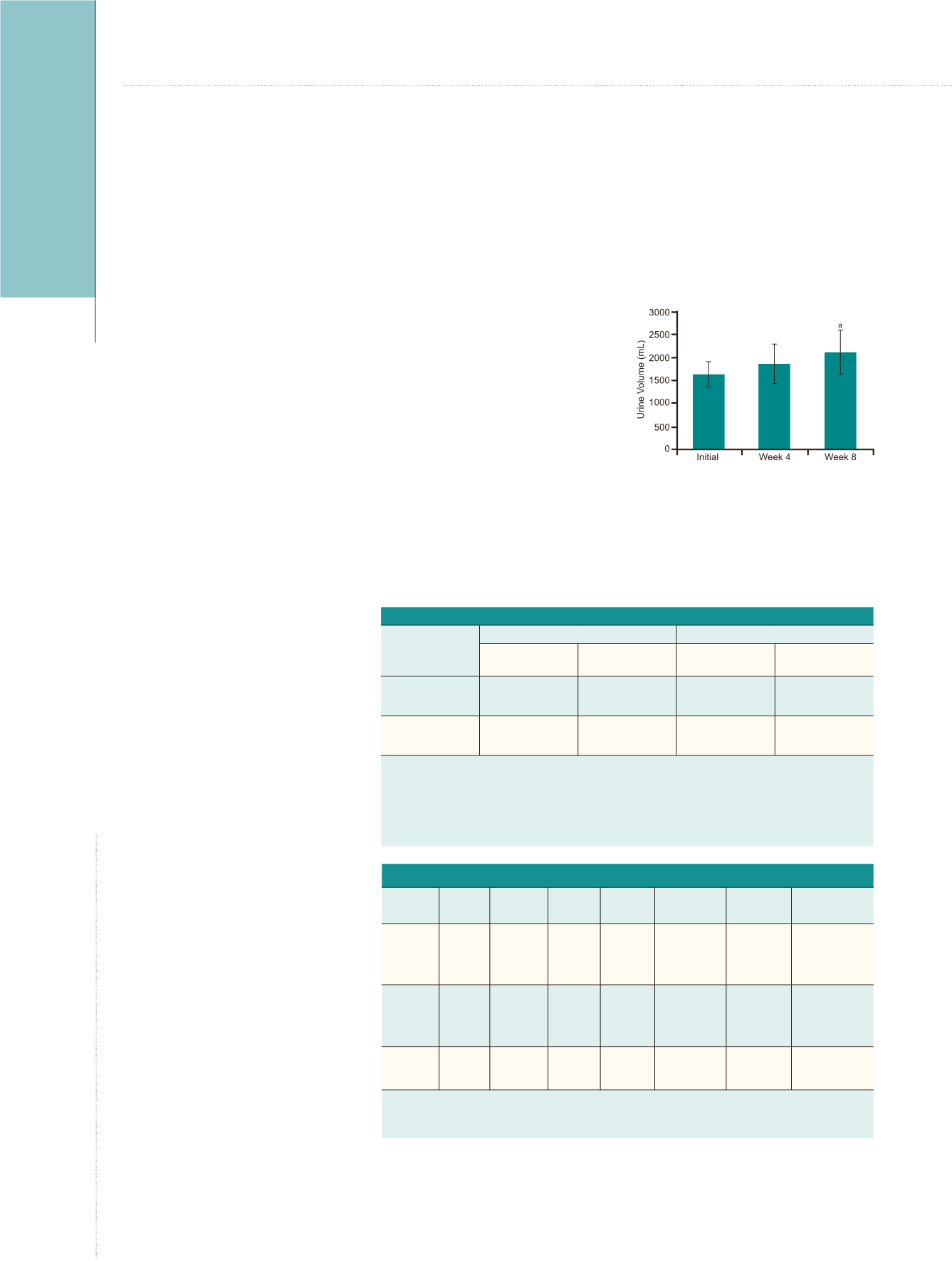
The meta-analysis also indicates that
Cystone improves urinary volume to a
significant level in 8 weeks (Figure 1).
It significantly decreases oxaluria, uric
acid, and calcium in the urine (Figures
2 and 3).
Figure 1.
Effect of Cystone on Urine Volume
in Stone Formers (n = 167)
Data represents mean ± SD at each week of
treatment.
a
P
< .01 as compared to initial value. The
levels observed in normal patients (n = 19)
for urine volume was 2551.51 mL.


