8
• Apr–Jun 2014 • Vol LIII • No 4
In Focus
Cystone Inhibits Struvite Crystal Growth in Single Diffusion
Gel Growth Technique
Jayaramaiah KK, et al
J Exp Integr Med.
2013;3(1):51–55.
Aim
This study aimed to evaluate the beneficial effect of Cystone, a
polyherbal formulation, against struvite crystal formation in an in
vitro model.
Materials and Methods
Struvite crystal growth inhibition property of Cystone was
evaluated by single diffusion gel growth technique, an excellent in
vitro model, which exactly mimics the complex growth of urinary
calculi in vivo.
Various concentrations of Cystone (0.5%, 1%, and 2%) were
prepared in 1 M magnesium acetate solution. An aqueous
solution of 0.5 M ammonium dihydrogen phosphate was mixed
with sodium metasilicate solution of specific gravity 1.05 to set
the pH at 7.2 and transferred to autoclaved glass test tubes for gel
formation. After gel formation, 20 mL supernatant solution of
pure 1 M magnesium acetate (control) and 20 mL supernatant
solution of 1 M magnesium acetate solution containing various
concentrations of Cystone (0.5%, 1%, and 2%) were gently
poured on the gels in the respective test tubes. This procedure
was performed under aseptic conditions. After pouring the
supernatant solutions, the test tubes were closed tightly and
incubated at room temperature. The formation of struvite crystals
were observed for 21 days.
The experiments were carried out in triplicates and at the end of
the study, the crystals were gently removed from the gel matrix
and quickly washed with phosphate buffered saline (PBS; pH 7.2)
solution. The total mass and volumes of crystals were measured
for all samples including control.
The results were expressed as mean ± SEM and analyzed
statistically by one-way ANOVA followed by Dunnett multiple
comparison test. The minimum level of significance was fixed at
95% confidence limit.
Results
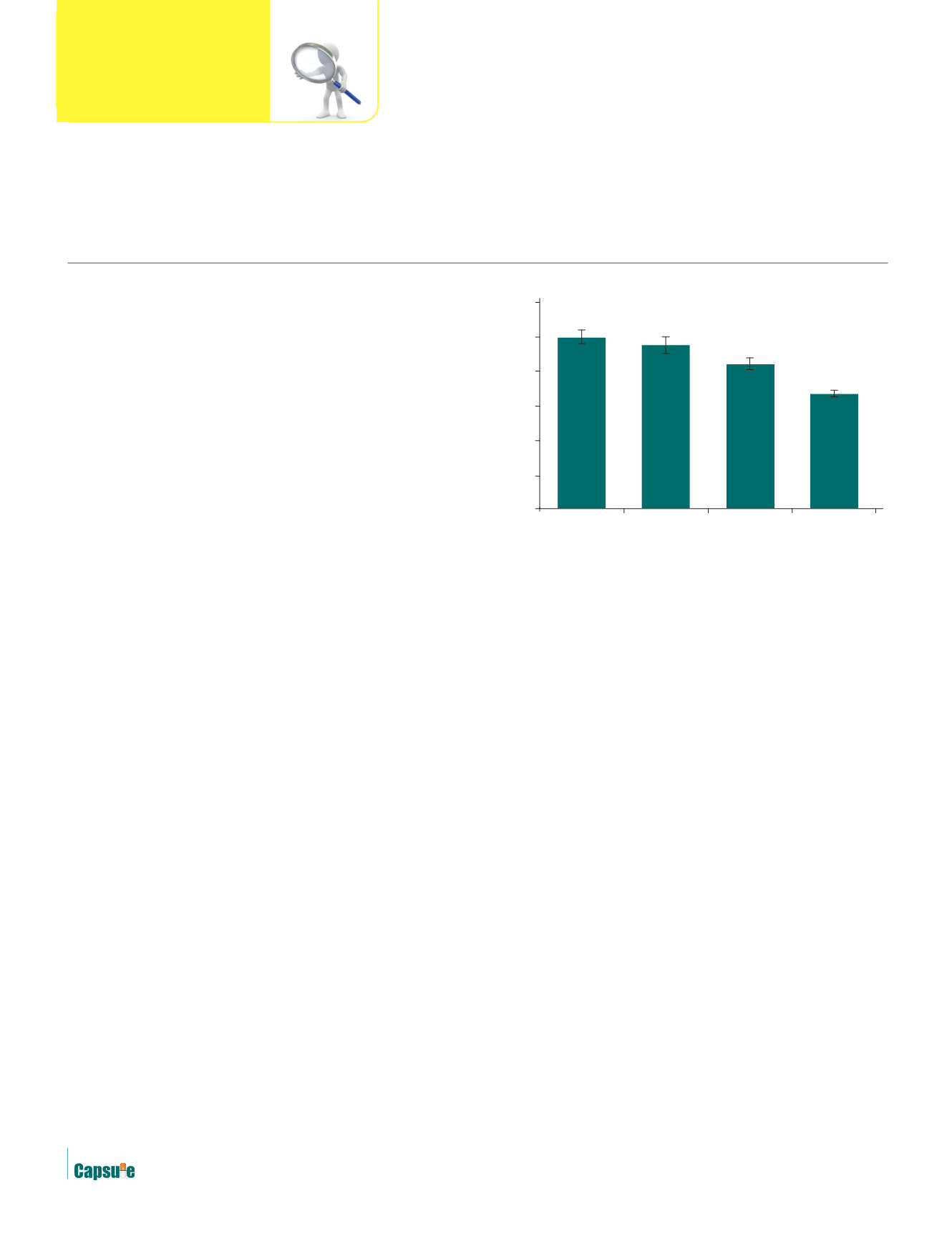
Cystone decreased the formation of struvite crystals in a
concentration-dependent manner, which was indicated by
decrease in mass (Figure 1) and volume of the crystals formed in
the gel matrix containing the drug. However, control test tubes
showed rapid crystal growth, indicated by increase in number,
total weight, and total volume of the crystals.
Furthermore, visual observation of the crystal size revealed
the presence of larger struvite crystals in the control test
tubes compared to test tubes with 1% and 2% Cystone. This
qualitatively small size of the struvite crystals could be due to the
fragmentation in the presence of Cystone.
Conclusion
The findings of the study revealed that Cystone could inhibit the
nucleation and aggregation of magnesium ammonium phosphate
hexahydrate (MAPH; struvite crystals) in a dose-dependent
manner. It significantly retards the formation of struvite stones
and brings about its fragmentation. Thus, Cystone is beneficial in
the clinical management of struvite urolithiasis.
Figure 1.
Concentration-dependent Decrease of Struvite Crystal Mass by Cystone in
Gel Matrix
Values are expressed as mean of 3 trials (n = 3) ± SEM.
a
P
< .05;
b
P
< .01, compared to control
500
477
422
336
a
b
Weight of Struvire Crystal (mg)
0
100
200
300
400
500
600
Control
Cystone (0.5%) Cystone (1%) Cystone (2%)


