Apr–Jun 2014 • Vol LIII • No 4
5
Clinical Quiescent Effect of
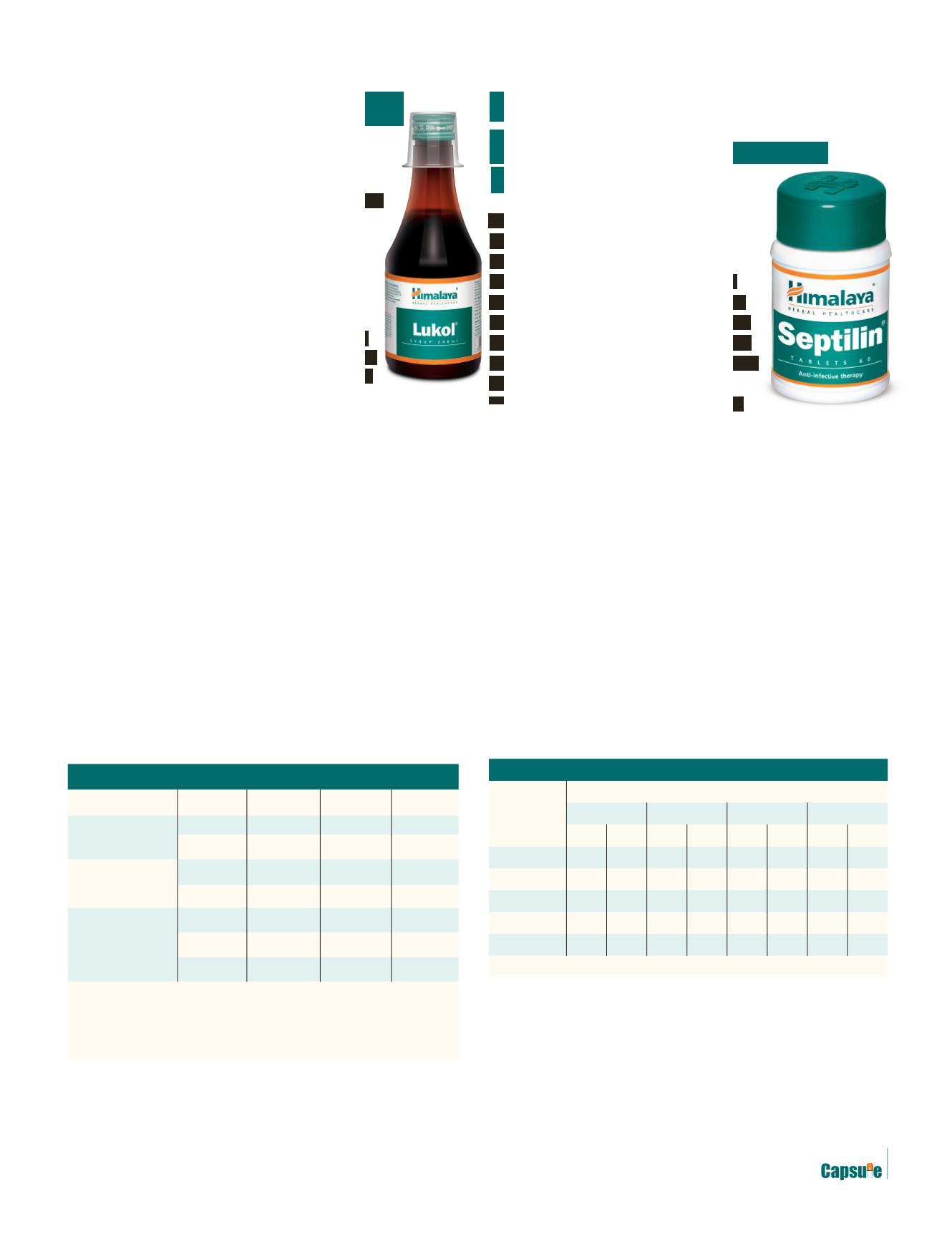
Septilin in Respiratory Tract
Infections
A clinical study was undertaken to study
the quiescence effect of Septilin tablets
on respiratory tract infection (RTI). The
study included 43 patients (17 males and
26 females) who were treated with Septilin
tablets for repeated attack of common cold,
RTI, or any similar complaints. Of 43 cases
treated, 11.62% were under 5 years, 55.83%
were between 6 and 15 years, 18.60%
were between 16 and 45 years, and 13.9%
were 46 years and above.
The treatment duration was for a period of 3 to 6 months. It
was observed that higher the period of treatment, lesser was the
complaint of RTI. The correlation between period of treatment
and duration of absence of complaint of RTI was found highly
significant (
r
= + 0.5626;
P
< .001), statistically.
Statistically significant difference was observed (
P
< .05) in both
sexes, particularly in the age group of 6 to 15 years, and after 4
to 6 months of treatment. Those who had more than 6 months
of treatment constituted 95.46% of the total respondents. They
did not have any side effect of the drug nor had any complaint
of repeated respiratory attack. The no complaints matrix of
43 respondents was plotted as no complaint versus period of
treatment (Table 4). It can be concluded that Septilin was
extremely well tolerated and showed positive quiescence effect on
respiratory tract infection.
Table 4.
No Complaint Matrix of Drug Therapy
Period of
Treatment
No Complaint With Drug
< 3 Months 3–6 Months 6–12 Months
> 1 Year
No.
% No.
% No.
% No.
%
< 3 Months
1 2.32 1 2.32 –
–
–
–
3–6 Months
–
–
–
–
3 6.97 7 16.28
6–12 Months
–
–
–
–
–
–
15 34.89
> 1 Year
–
–
–
–
–
– 16 37.32
Total
1 2.32 1 2.32 3 6.97 38 88.37
r
= + 0.5626;
t
= 4.358;
P
< .001.
Source
:
Mohapatra P, et al.
Indian J Prev Soc Med
. 2002;30(1-2):42–46.
Safety and Efficacy of Lukol
Syrup in Leukorrhea
A randomized, double-blind, placebo-controlled
clinical study was undertaken to evaluate the clinical
efficacy and safety of Lukol syrup in relieving
symptoms associated with leukorrhea.
Seventy women above 30 years of age with
symptoms of leukorrhea were enrolled and
randomized into 2 groups of 35 each—Lukol
syrup group and placebo group. Patients in the
Lukol group received Lukol syrup at a dosage of 2
teaspoonfuls twice daily for 4 weeks and patients in
the placebo group received similar looking placebo
at the same dosage for 4 weeks. All patients were
followed up at weeks 2 and 4 for symptom evaluation.
Reduction in the symptoms was seen from day 1 till the
end of the study. Patients in the Lukol group showed
significant improvement in symptoms of leukorrhea (Table 3).
Microbiological evaluation showed the presence of
Candida
albicans
in 25 patients in Lukol group and 27 patients in placebo
group before treatment. After 4 weeks of treatment with Lukol
syrup, there was marked reduction in the number of patients
having
C albicans
. However, significance was missing in the Lukol
group. In the placebo group,
C albicans
persisted in 16 patients
after treatment. Similarly,
Trichomonas vaginalis
was present in 26
patients in the Lukol group and 30 patients in the placebo group
before treatment. At the end of treatment, there was a significant
(
P
< .0224) reduction in patients having
T vaginalis
in the Lukol
group as compared to placebo.
There were no clinically significant adverse reactions observed
during the study. Thus, Lukol syrup is effective and safe in
relieving symptoms of leukorrhea.
Table 3.
Efficacy of Lukol Syrup in Symptoms of Leukorrhea
Parameters
Duration Lukol Syrup Placebo
P
Values
Itching in Vulva
and Vagina
Week 2 1.14 ± 0.43 0.82 ± 0.46 < .0362
Week 4 1.63 ± 0.65 1.17 ± 0.62 < .0097
Pain in Vulva
and Vagina
0.43 ± 0.56 0.11 ± 0.32 < .0322
Week 4 0.46 ± 0.61 0.11 ± 0.32 < .0303
Backache
Day 1 0.77 ± 0.77 0.71 ± 0.86
NS
0.23 ± 0.55 0.29 ± 0.46
NS
Week 4 0.14 ± 0.49 0.14 ± 0.36
NS
NS, not significant.
Statistical test: Mann Whitney test
Note: For itching of vulva and vagina and pain in vulva and vagina the
change in the values from baseline to each follow up was considered as
there was a statistical significance at baseline for Lukol syrup versus placebo.
Source
:
Moharana PK. Data on file.
Week 2
Week 2


