Apr–Jun 2014 • Vol LIII • No 4
3
Health from Herbs
English name Margosa tree
Sanskrit/Indian name Nimba
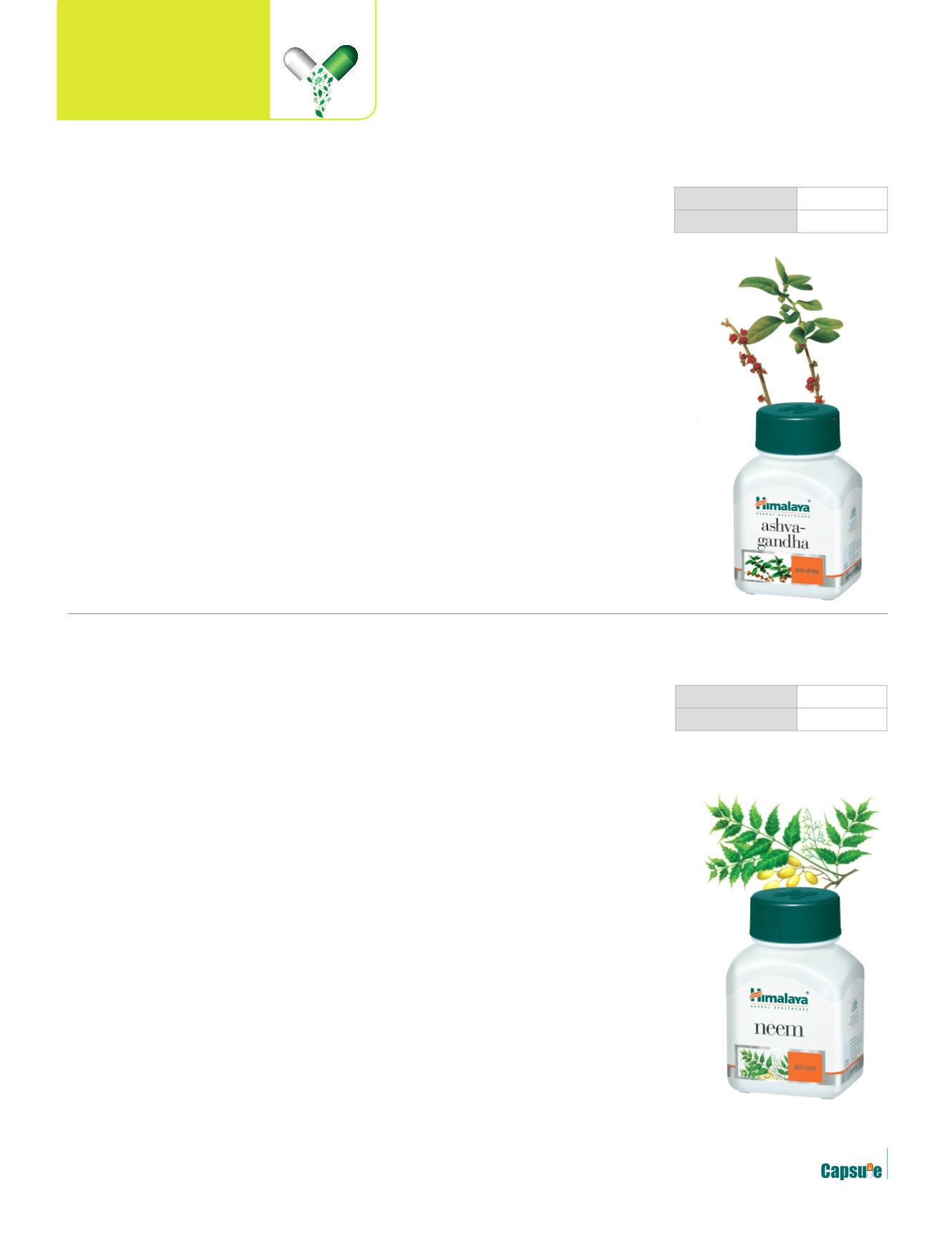
English name Winter cherry
Sanskrit/Indian name Ashvagandha
Withania somnifera
Withania somnifera
is a small, erect, branched,
evergreen, woody shrub that grows around
150 to 170 cm. It is found throughout
the drier parts of India. Leaves are simple,
petiolate, elliptic-ovate to broadly ovate, entire,
exstipulate, cuneate or oblique, glabrous, up to
10 cm long; those in the floral region are smaller
and opposite. The flowers are greenish and
fruits are small, round, and orange-red when
mature.
W somnifera
possesses nervine, tonic,
and sedative properties. In traditional systems
of medicine,
W somnifera
has been used to treat
nervine debility, stress, anxiety, blood pressure,
insomnia, and as an everyday health supplement
to cope with modern day stress.
1
A study was conducted on isolation-reared
rats to evaluate the effect of
W somnifera
root
extract on social isolation-induced behaviors,
such as, anxiety and depression. It was observed
that the treatment with
W somnifera
showed
antidepressant effect and mood-stabilizing
activities. It was noted that administration of
W somnifera
increased the entries into the open
arms on elevated plus maze (EPM) test and
time spent there; it reduced immobility time in
forced swim test (FST), indicating the use of
this herb as a mood stabilizer in social isolation-
induced behavior.
2
Another study showed that
W somnifera
brought
significant relief from anxiety symptoms
and fatigue, and improved mental health,
concentration, vitality, social functioning, and
overall quality of life in patients with moderate
to severe anxiety.
3
References
1. Rao BR, et al.
J Pharmacogn.
2012;3(2):88–91.
2. Gupta GL, Rana AC.
Indian J Physiol Pharmacol.
2007;51(4):345–353.
3. Cooley K, et al.
PLoS One.
2009;4(8):e6628.
Azadirachta indica
Azadirachta indica
is native to India, naturalized
in most of the tropical and subtropical countries,
and distributed widely across the world.
A indica
is known for its great medicinal use. In ayurvedic
medicine, it has been used for more than 4000
years.
A indica
has been used in the Indian
ayurvedic and Unani medicines and is now being
used in pharmaceutical and cosmetic industries.
1
Biologically active principles isolated from
different parts of the plant include azadirachtin,
nimbidin, and nimbolides.
A literature survey revealed that
A indica
exhibits
antibacterial, antiviral, anti-inflammatory,
and immunomodulatory properties.
2
Oil
from the leaves, seeds, and bark possesses a
wide spectrum of antibacterial action against
various microorganisms, such as,
Mycobacterium
tuberculosis
,
Streptococcus faecalis
,
Vibrio cholerae
,
Klebsiella pneumoniae
,
Streptococcus pyogenes
, and
streptomycin-resistant strains.
3
In an experimental study, 400 mg/kg extract
of
A indica
showed significant increase in
phagocytic index, which indicates activation of
reticuloendothelial system through the release
of the chemical mediators, such as cytokines,
histamine, and TNF-
α
.
A indica
extract also exhibited effective
immunomodulatory action by both specific
(humoral and cell mediated immunity) and
nonspecific immune response (cytotoxic and
phagocytic activity of macrophages).
4
Another
study showed that
A indica
is a potent antiviral
agent, which acts by inhibiting the initial stage
of viral replication.
5
References
1. Hashmat I, et al.
Int Res J Biol Sci.
2012;1(6):76–79.
2. Subapriya R, et al.
Curr Med Chem Anti-cancer Agents.
2005;5(2):149–156.
3. Biswas K, et al.
Curr Sci.
2002;82(11):1336–1345.
4. Shah AS, et al.
J Nat Rem.
2009;9(1):35–42.
5. Faccin-Galhardi LC, et al.
J Ethnopharmacol.
2012;142(1):86–90.


